PROLOGUE: THE CIA SCULPTURE & THE 36-YEAR MYSTERY
In November 1990, American sculptor Jim Sanborn and retired CIA cryptographer Edward M. Scheidt dedicated *Kryptos* in the courtyard of the New Headquarters Building at CIA Headquarters in Langley, Virginia. The centerpiece of the artwork is a monumental, curved, S-shaped copper screen perforated with 1,735 alphabetical characters across four distinct encrypted passages: **K1**, **K2**, **K3**, and the legendary unsolved **K4** (97 letters).
Over three decades, while K1, K2, and K3 yielded to classical cryptanalysis, K4 remained uncracked. In 2024–2026, research cryptographer Dan Robinson launched **Paradigm Kryptos**—a ten-challenge suite (**PK1 through PK10**) that serves as an architectural, algorithmic, and narrative homage to the physical sculpture. The suite expands upon the historical and mechanical principles of Kryptos: Quagmire polyalphabetic substitution, classical columnar transposition, matrix transformations, and multi-clock additive keystreams over the keyed **Kryptos alphabet**:
K R Y P T O S A B C D E F G H I J L M N Q U V W X Z
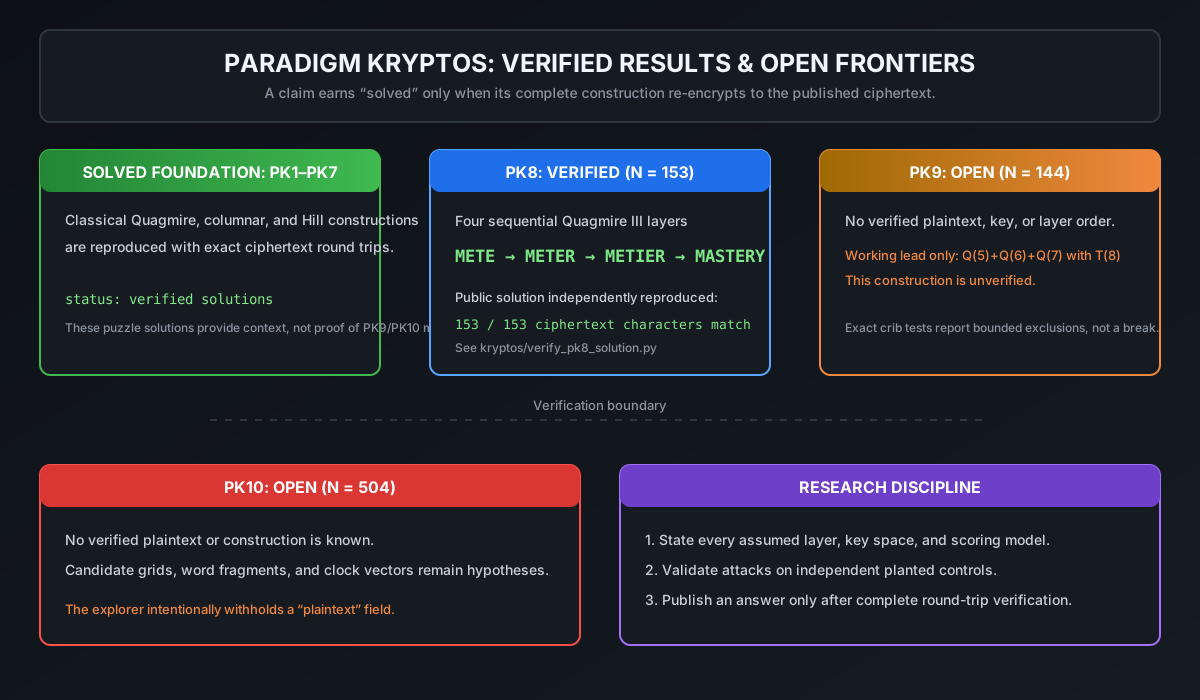
This research reader separates verified results from active investigation: it documents the solved PK1–PK8 sequence and the open PK9 and PK10 challenges without presenting speculation as a decryption.
---
##
CHAPTER 1: THE NARRATIVE ARC OF PARADIGM KRYPTOS (PK1 – PK7)
Unlike disjoint cryptographic puzzles, the challenges of Paradigm Kryptos form a single, continuous, chronological first-person narrative. The story documents an apprentice archivist searching for the legendary "needle of Pellegrin" capable of unraveling an ancient knot to unlock the lost archives of Francisque Pellegrin (the 16th-century Florentine artist who published *La Fleur des patrons de broderie* in Lyons, 1530).
1.1 Summary of Solved Foundations (PK1 – PK7)
1. **PK1 — The Accession Log ($N = 192$)**:
- *Cipher*: Quagmire III over Kryptos alphabet.
- *Key*: `PROVENANCE` (Period 10).
- *Plaintext*:
```text
INVESTIGATION LOG ITEM EIGHT KNOT TIGHTLY WOUND ITS THREAD INSCRIBED WITH LETTERS THE ACCESSION LOG SAYS ONCE UNRAVELED IT REVEALS THE ROUTE TO THE LOST ARCHIVE OF PELLEGRIN TWELVE PRIOR ARCHIVISTS TRIED TO UNRAVEL IT ALL FAILED
```
2. **PK2 — Pellegrin's Treatise ($N = 350$)**:
- *Cipher*: Complete Columnar Transposition ($50 \text{ rows} \times 7 \text{ cols}$).
- *Key*: `MARGINS` (Column permutation: `[1, 3, 4, 0, 5, 2, 6]`).
- *Plaintext*: References Pellegrin's treatise on textiles: *"un ago tanto sottile da leggere qualunque nodo"* (a needle so fine as to read any knot!).
3. **PK3 — The Viennese Anatomist ($N = 280$)**:
- *Cipher*: Quagmire III with two-clock additive keystream ($p_{10} + p_8$, period 40).
- *Keys*: `PENTIMENTO` (10) + `ORDINATE` (8).
- *Plaintext*: The narrator searches six countries; a Viennese anatomist recalls a surgical demonstration in Bern where such an ultra-fine needle was used.
4. **PK4 — The Furlongs of Thread ($N = 224$)**:
- *Cipher*: Columnar Transposition ($28 \times 8$) + Dual-Clock Quagmire III ($p_5 + p_9$, period 45).
- *Plaintext*: The threads measure two furlongs; microscopic characters are engraved along their lengths, rising in complexity towards the core.
5. **PK5 — The Flax Fibers Under the Lens ($N = 272$)**:
- *Cipher*: Columnar Transposition ($17 \times 16$) + Quagmire III (Period 17).
- *Plaintext*: Flax fibers inspected under magnification; folded letters form an interlocking grid of coordinates pointing to Bern.
6. **PK6 — The Whitesmith's Workshop ($N = 315$)**:
- *Cipher*: Compound Double Columnar Transposition ($9 \times 35 \to 9 \times 35$) + Quagmire III ($p_6$).
- *Key*: `PORTAL` (Period 6).
- *Plaintext*: The narrator arrives at the master whitesmith's workshop. The gutter is strewn with exquisite needles: *"they are only the residue of my practice... study under me for ten years and you may take one of your own making."*
7. **PK7 — The Glowing White Hearth ($N = 279$)**:
- *Cipher*: Quagmire III (Period 6) + $3 \times 3$ Affine Hill Matrix over $\mathbb{Z}_{26}$.
- *Plaintext*: The master points to the bellows and white-hot coals, giving the crucial metallurgical warning:
```text
HE POINTED TO THE HEARTH AND SAID THAT THE WORK COULD ONLY BEGIN WHEN THE FIRE REACHED ITS PROPER HEAT WITH LONG TONGS HE HELD THE STEEL INTO COALS THAT GLOWED WHITE IN THE BELLOWS WARNING ME THAT ONE MOMENT OF TEMPERING CAN DESTROY YEARS OF LABOUR FOR ONLY AN IRON PIECE PURIFIED NINE DAYS IN THE FLAME WILL HOLD A FINE ENOUGH EDGE TO BE FORGED
```
---
##
CHAPTER 2: PK8 — VERIFIED SOLUTION AND REPRODUCIBLE METHOD
2.1 Exact construction
PK8 is solved. It applies four sequential Quagmire III layers over the keyed alphabet KRYPTOSABCDEFGHIJLMNQUVWXZ, in encryption order:
METE → METER → METIER → MASTERYThe 153-character plaintext is:
ILEAVEATMIDNIGHTBEFOREGOINGIPICKUPONENEEDLEFROMTHEGUTTERIAMGRATEFULTOMYTEACHERBUTTHEARCHIVEISMYTRUECALLINGANDTHEKNOTAWAITSILEAVETHEWHITESMITHASHORTLETTER2.2 Checkable recovery and verification
To decrypt, apply the same layers in reverse order. The repository verifier encrypts this plaintext in the displayed order and decrypts the official ciphertext in reverse; both operations match all 153 characters. Its plaintext SHA-256 is 4c144cd2bd54b4cfac0c493d21a3a52d635844017070e19662b5f9ab9c447e7c.
A retrospective ciphertext-only recovery is also included in break_pk8_structured.c: enumerate dictionary insertion ladders of lengths 4, 5, and 6; score each residual period-7 slice to recover the final wheel; then rank the resulting complete decryptions with English quadgrams. The rank-one chain is METE → METER → METIER and the recovered seven-letter wheel is MASTERY. This is a reproducible recovery method, not a claim that PK8 had been independently solved before the public answer appeared.
CHAPTER 3: PK9 — OPEN RESEARCH FRONTIER (N = 144)
PK9 is unsolved. No PK9 plaintext, key, padding scheme, or transposition order presented in this application should be treated as established unless it comes with a full re-encryption check against the 144-letter source ciphertext.
3.1 Current bounded work
A public community lead models three Quagmire III wheels of lengths 5, 6, and 7 with a complete width-8 transposition. This is an unverified hypothesis, not an official construction. The exact crib tools test finite portions of that hypothesis with planted controls that recover known synthetic messages before they are used on PK9.
Current negative results include an exhaustive direct PK8-wheel bridge: all rotations and reversals of METER / METIER / MASTERY, all 26 common KRYPTOS-index offsets, both layer orders around a complete width-8 transposition, and all 8! column assignments. Insertion-ladder word families and generated narrative and short-letter crib corpora have also been tested. These results rule out only the tested combinations. They do not prove the proposed architecture, nor do they yield a plaintext.
The research ledgers are kryptos/PK9_Q567_T8_EXACT_CRIB_REPORT.md and kryptos/PK9_PK8_PHASE_BRIDGE_REPORT.md.
CHAPTER 4: PK10 — OPEN RESEARCH FRONTIER (N = 504)
PK10 is unsolved. The application deliberately displays only the official ciphertext and an explicit unsolved status. It does not label high-scoring rearrangements, apparent word fragments, guessed clock vectors, panels, padding, or coordinate patterns as plaintext.
A valid PK10 solution must provide a precise reversible construction and reproduce every ciphertext character. Until then, proposed arrangements remain hypotheses.
CHAPTER 5: RESEARCH-INTEGRITY RULES
A candidate is not a solution merely because it has English-looking fragments, a favorable n-gram score, an appealing narrative, or a geometric coincidence. This explorer now maintains a strict distinction:
- Solved: a complete method re-encrypts to the published ciphertext.
- Hypothesis: an architecture or key family with clear assumptions.
- Negative result: a tested finite subset that produced no verified answer.
PK9 and PK10 belong to the latter two categories, not the first.
CHAPTER 6: NEXT PK9 STEPS
The most useful next work is hypothesis-led and reproducible: collect independent source evidence for a construction, extend exact tests with synthetic controls, and prefer methods that couple key structure to the transposition without assuming a guessed plaintext. Repeating unconstrained optimization is not evidence of a break; on short text it can overfit noise.
CHAPTER 7: VERIFICATION COMMANDS
python3 kryptos/verify_pk8_solution.py
cc -O3 -march=native -fopenmp kryptos/break_pk8_structured.c -o /tmp/pk8 -lm
/tmp/pk8 --self-test
cc -O3 -march=native -fopenmp kryptos/crack_pk9_q567_t8_crib.c -o /tmp/pk9 -lm
/tmp/pk9 --self-test
The PK8 commands verify a solution. The PK9 command validates a research tool and its synthetic control; it does not claim a PK9 solve.
EPILOGUE: STATUS AS OF 2026-10-01
PK1–PK8 are solved. PK9 and PK10 remain open on the official Paradigm leaderboard. This reader will show future answers only after a complete, independently checkable round trip.